Descripción general del sistema

Solicitud: Compact case erecting, packing, and sealing system for 2.5-gallon jugs
Velocidad: 24 jugs and 12 cases per minute
Desafíos únicos: New to automation, the customer needed a compact solution that would reliably make rate while freeing up operators to perform other tasks
Diseño de sistemas

Sistema en acción

Descripción de la operación
The line includes a Pearson Case Erector, Robotic Top Load Case Packer and Case Sealer.
Entre las características más destacadas del sistema se incluyen:
- Fanuc R1000 Robot and R-30i controller with enhanced iPendant programming pendant
- Digital Twin validation to ensure rates and reduce startup risk
- Icon based HMI navigation, graphical fault recovery and guided change over instructions
- Allen-Bradley CompactLogix Programmable Logic Controller
The CE25-T Case Erector automatically forms the cases. To fit into the available space, the case erector and conveying to the loading cell is positioning across from the case packer and sealer in a parallel layout.
For automated robotic case loading, product will be received from the customer conveyor in a single lane. Product should be received short-side leading. Cases are conveyed into the cell short-side leading and contact accumulated in the buffer position. A case escapement will release cases one at a time to a single pack station. A product escapement will release product one at a time to a single pick station. The robot will pick one shrink bundle at a time from the infeed conveyor and place the product into a single case in a smooth motion. Each case receives two robot cycles as each pack configuration is stacked 2-high. Once full, the case is released to the takeaway conveyor and the process is repeated. Placement into the case is fully programmable by independent control of the axes
Pearson’s CS25-42T Case Sealer top seals a wide-range of case sizes with pressure sensitive tape at speeds of 25 to 42 cases per minute depending on case length. A convenient bypass option eliminates the need for additional conveying when pre-sealed boxes or HSCs are introduced into the line.
Componentes del sistema
This jug packaging line is comprised of the following Pearson machines. Click on the image to explore the standard product features interactively or visit the product page for more details.
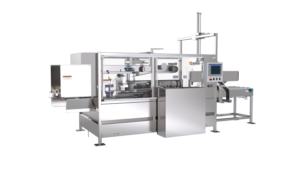
Formadora de cajas
CE25
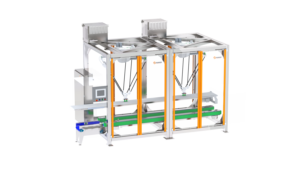
empacadora de cajas
RTL-MX
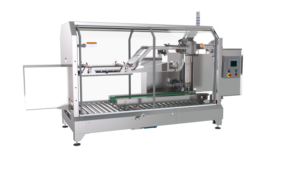
Selladora de cajas
CS25
Diseño centrado en el usuario
El diseño centrado en el usuario busca que la interacción con nuestras máquinas sea lo más intuitiva posible. Todas las máquinas Pearson cuentan con una interfaz de usuario uniforme y altamente intuitiva, que sigue los principios comunes del diseño web, con iconos familiares, mapas interactivos e instrucciones gráficas paso a paso. Nuestro objetivo es reducir la curva de aprendizaje para sus operadores y técnicos de mantenimiento, minimizar el margen de error humano y lograr que la configuración, el cambio de formato y la recuperación de fallos sean procesos rápidos y fluidos, lo que se traduce en un mayor tiempo de actividad y disponibilidad del equipo.
Gemelo digital

Before the system was ever built, Pearson used Digital Twin technology to emulate and test performance. This provided three major benefits:
Debugged programs before startup: PLC, HMI, and robot code were functionally tested in advance, reducing on-floor debug to only what’s required for running physical product.
Validated design: Electrical and mechanical layouts, including sensor placement and quantity, were confirmed virtually. Adjustments were made early to prevent costly changes later.
Confirmed production rates: By running actual conveyor and robot speeds in the simulation, engineers ensured the system would achieve promised throughput and identified areas needing attention before the build.
 English
  Español de México